

KLI Colloquia are invited research talks of about an hour followed by 30 min discussion. The talks are held in English, open to the public, and offered in hybrid format.
Join via Zoom:
https://us02web.zoom.us/j/5881861923?omn=85945744831
Meeting ID: 588 186 1923
Fall-Winter 2026/27 KLI Colloquium Series
1 October 2026 (Thurs) 3-4:30 PM CET 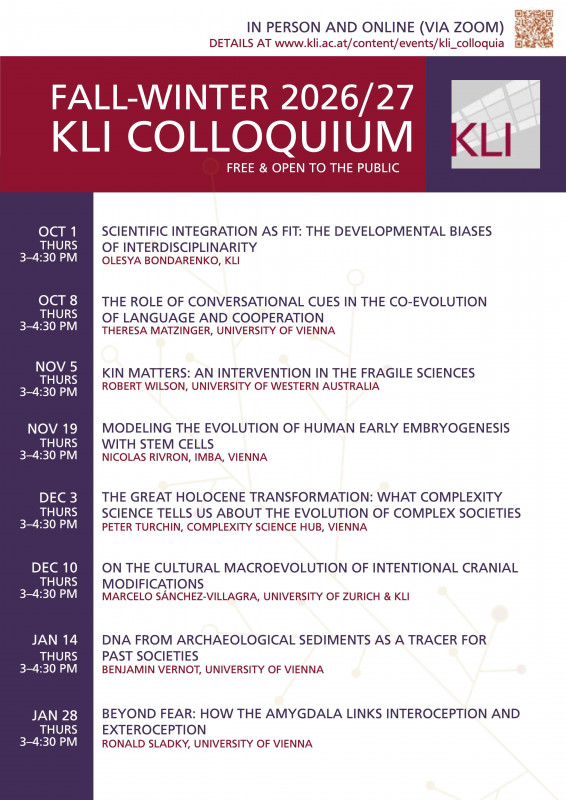
Scientific Integration as Fit: The Developmental Biases of Interdisciplinarity
Olesya BONDARENKO (KLI)
8 October 2026 (Thurs) 3-4:30 PM CET
The Role of Conversational Cues in the Co-Evolution of Language and Cooperation
Theresa MATZINGER (University of Vienna)
5 November 2026 (Thurs) 3-4:30 PM CET
Kin Matters: An Intervention in the Fragile Sciences
Robert A. WILSON (University of Western Australia)
19 November 2026 (Thurs) 3-4:30 PM CET
Modeling the Evolution of Human Early Embryogenesis with Stem Cells
Nicolas RIVRON (Institute of Molecular Biotechnology/IMBA, Vienna)
3 December 2026 (Thurs) 3-4:30 PM CET
Peter TURCHIN (Complexity Science Hub, Vienna)
10 December 2026 (Thurs) 3-4:30 PM CET
On the Cultural Macroevolution of Intentional Cranial Modifications
Marcelo SÁNCHEZ-VILLAGRA (University of Zurich)
14 January 2027 (Thurs) 3-4:30 PM CET
DNA from Archaeological Sediments as a Tracer for Past Societies
Benjamin VERNOT (University of Vienna)
28 January 2027 (Thurs) 3-4:30 PM CET
Beyond Fear: How the Amygdala Links Interoception and Exteroception
Ronald SLADKY (University of Vienna)
KLI Colloquia 2014 – 2026
Event Details
Topic description:
Why do cultures change? In the present talk I will present new research exploring cultural change in eight cultural-level markers, or correlates, of individualism in the United States, all of which increased over the course of the 20th century: frequency of individualist themes in books, preference for uniqueness in baby naming, frequency of single-child relative to multichild families, frequency of single-generation relative to multigeneration households, percentage of adults and percentage of older adults living alone, small family size, and divorce rates (relative to marriage rates). I will further show results from tests of six key hypotheses regarding cultural change in individualism-collectivism. As predicted by previous theories, changes in socioeconomic structure, pathogen prevalence, and secularism accompanied changes in individualism averaged across all measures. The relationship with changes in individualism was less robust for urbanization. Contrary to previous theories, changes in individualism were positively (as opposed to negatively) related to the frequency of disasters and not at all related to shifts in climatic demands. Time-lagged analyses suggested that only socioeconomic structure had a robust effect on individualism; changes in socioeconomic structure preceded changes in individualism. I will discuss implications of this work for anthropology, biology, psychology, and sociology.
Biographical note:
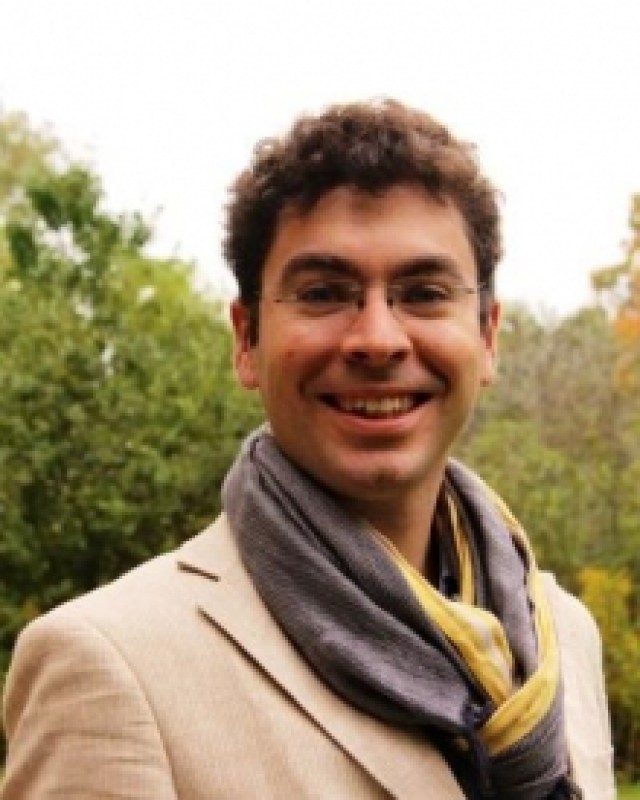
Igor Grossmann is a world traveller: Born in the Soviet Union, he lived in Ukraine, Germany, and the U.S. Currently, he is an Assistant Professor of Psychology and the director of the “Wisdom and Culture” laboratory at the University of Waterloo, Canada. Prof. Grossmann has published widely, including such journals as the Proceedings of the National Academy of Sciences of the U.S.A., Psychological Science, or Journal of Experimental Psychology, and it has been recognized through numerous awards, including two RISE Awards from the Association for Psychological Science, a Dissertation Award from the American Psychological Association (Division 20), The Otto Klineberg Intercultural and International Relations Award from The Society for the Psychological Study of Social Issues, and the President’s New Investigator Award from the Canadian Psychological Association.
