

KLI Colloquia are invited research talks of about an hour followed by 30 min discussion. The talks are held in English, open to the public, and offered in hybrid format.
Join via Zoom:
https://us02web.zoom.us/j/5881861923?omn=85945744831
Meeting ID: 588 186 1923
Fall-Winter 2026/27 KLI Colloquium Series
1 October 2026 (Thurs) 3-4:30 PM CET 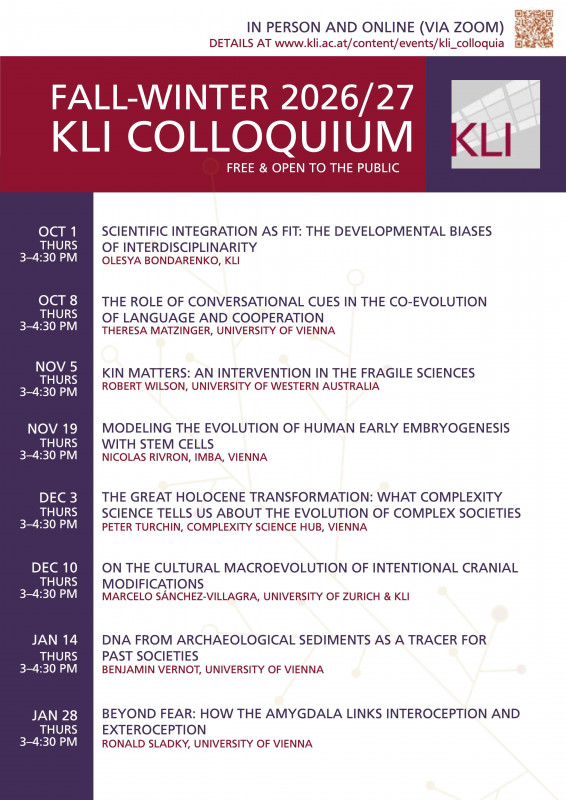
Scientific Integration as Fit: The Developmental Biases of Interdisciplinarity
Olesya BONDARENKO (KLI)
8 October 2026 (Thurs) 3-4:30 PM CET
The Role of Conversational Cues in the Co-Evolution of Language and Cooperation
Theresa MATZINGER (University of Vienna)
5 November 2026 (Thurs) 3-4:30 PM CET
Kin Matters: An Intervention in the Fragile Sciences
Robert A. WILSON (University of Western Australia)
19 November 2026 (Thurs) 3-4:30 PM CET
Modeling the Evolution of Human Early Embryogenesis with Stem Cells
Nicolas RIVRON (Institute of Molecular Biotechnology/IMBA, Vienna)
3 December 2026 (Thurs) 3-4:30 PM CET
Peter TURCHIN (Complexity Science Hub, Vienna)
10 December 2026 (Thurs) 3-4:30 PM CET
On the Cultural Macroevolution of Intentional Cranial Modifications
Marcelo SÁNCHEZ-VILLAGRA (University of Zurich)
14 January 2027 (Thurs) 3-4:30 PM CET
DNA from Archaeological Sediments as a Tracer for Past Societies
Benjamin VERNOT (University of Vienna)
28 January 2027 (Thurs) 3-4:30 PM CET
Beyond Fear: How the Amygdala Links Interoception and Exteroception
Ronald SLADKY (University of Vienna)
KLI Colloquia 2014 – 2026
Event Details

Join Zoom Meeting
https://us02web.zoom.us/j/5881861923?omn=85945744831
Meeting ID: 588 186 1923
Topic description / abstract
The study of cross-species differences in the organization of the cerebral cortex received significant attention during the past century. However, the evolutionary principles governing changes in brain connectivity and their impact on cognition remain poorly understood. In the current talk, I will present a recent analysis of anatomical input from the neocortex to the hippocampal region across six species spanning more than 100 million years of mammalian evolution - the tenrec, rat, cat, marmoset, macaque, and human. The results demonstrate that unlike direct transmodal cortical input, direct unimodal cortical input to the hippocampal region was selectively eliminated with the increase in brain size. These findings suggest that hippocampus-related processes in different species operate on fundamentally different types of information, potentially underpinning cross-species differences in hippocampus-dependent cognition. Furthermore, these findings outline the evolutionary trajectory of the anatomical circuitry associating the human hippocampal region with the neocortex.
Biographical note
Daniel was born in Vladivostok, Russia, and moved to Israel during his teenage years. He took undergraduate courses in psychology, sociology, and anthropology, and earned a BA from Ben-Gurion University of the Negev, Israel (magna cum laude). He then completed his PhD in neuroscience through a direct track at Tel Aviv University, Israel. After graduating, he trained in advanced imaging methods, comparative hippocampal anatomy, and computational modeling at the Department of Psychology and the Centre for Brain Sciences at Harvard University, USA. Afterwards, he continued his training at the Max Planck Society, Germany, where he deepened his knowledge in 7-Tesla MRI and evolution. After recently securing an ERC Starting Grant, Daniel is about to open his own lab and embark on an independent research path into the nature and evolution of human memory.
