

KLI Colloquia are invited research talks of about an hour followed by 30 min discussion. The talks are held in English, open to the public, and offered in hybrid format.
Join via Zoom:
https://us02web.zoom.us/j/5881861923?omn=85945744831
Meeting ID: 588 186 1923
Fall-Winter 2026/27 KLI Colloquium Series
1 October 2026 (Thurs) 3-4:30 PM CET 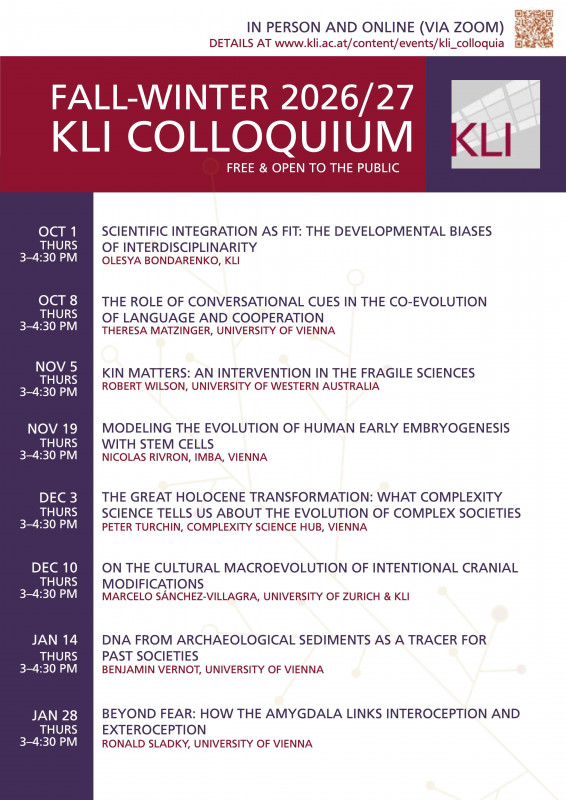
Scientific Integration as Fit: The Developmental Biases of Interdisciplinarity
Olesya BONDARENKO (KLI)
8 October 2026 (Thurs) 3-4:30 PM CET
The Role of Conversational Cues in the Co-Evolution of Language and Cooperation
Theresa MATZINGER (University of Vienna)
5 November 2026 (Thurs) 3-4:30 PM CET
Kin Matters: An Intervention in the Fragile Sciences
Robert A. WILSON (University of Western Australia)
19 November 2026 (Thurs) 3-4:30 PM CET
Modeling the Evolution of Human Early Embryogenesis with Stem Cells
Nicolas RIVRON (Institute of Molecular Biotechnology/IMBA, Vienna)
3 December 2026 (Thurs) 3-4:30 PM CET
Peter TURCHIN (Complexity Science Hub, Vienna)
10 December 2026 (Thurs) 3-4:30 PM CET
On the Cultural Macroevolution of Intentional Cranial Modifications
Marcelo SÁNCHEZ-VILLAGRA (University of Zurich)
14 January 2027 (Thurs) 3-4:30 PM CET
DNA from Archaeological Sediments as a Tracer for Past Societies
Benjamin VERNOT (University of Vienna)
28 January 2027 (Thurs) 3-4:30 PM CET
Beyond Fear: How the Amygdala Links Interoception and Exteroception
Ronald SLADKY (University of Vienna)
KLI Colloquia 2014 – 2026
Event Details
Join via Zoom:
https://us02web.zoom.us/j/5881861923?omn=85945744831
Meeting ID: 588 186 1923
Topic description / abstract
In philosophy of science as well as beyond it, integration between scientific disciplines has often been understood in terms of the scientific or practical problems it aims to solve. On this view, integration is driven by the need to address specific challenges—for instance, providing multilevel explanations or designing effective interventions—which individual fields cannot tackle on their own. Furthermore, the scientific products that result from integration are thought to be directly shaped by the problems that called them into existence. In this talk, I argue that the problem-solving view has a blind spot in that it overlooks the constructive aspects of integration and the effect these have on integrative outcomes. By way of a corrective, I offer an account of scientific integration as fit: in at least some cases, integration seeks to establish structural alignment between epistemic elements of contributing fields. While specific forms of such alignment may be more straightforward or feasible to achieve (which explains why researchers reach for them), they are not necessarily the most conducive to solving the problem(s) at hand. To illustrate, I discuss a proposed integration between behavioural genetics and cultural evolutionary theory (CET) (Uchiyama et al., 2022). I show that, even though the proposal is motivated by representing the complex and dynamic nature of the relationship between genetic and cultural determinants of behaviour, its use of variance partitioning models as the organising structure to which insights from CET can be “fitted” is in tension with the realisation of this goal. I end by suggesting that the above aspects of integration can be fruitfully understood through a (loose) analogy with discussions in evolutionary developmental biology, where scientists have considered how developmental structures shape the phenotypic variation available to selection. On this analogy, interdisciplinary research may be biased toward particular outcomes developmentally, which complicates its view solely in terms of problem solving and calls attention to the processes that underlie its construction.
Biographical note
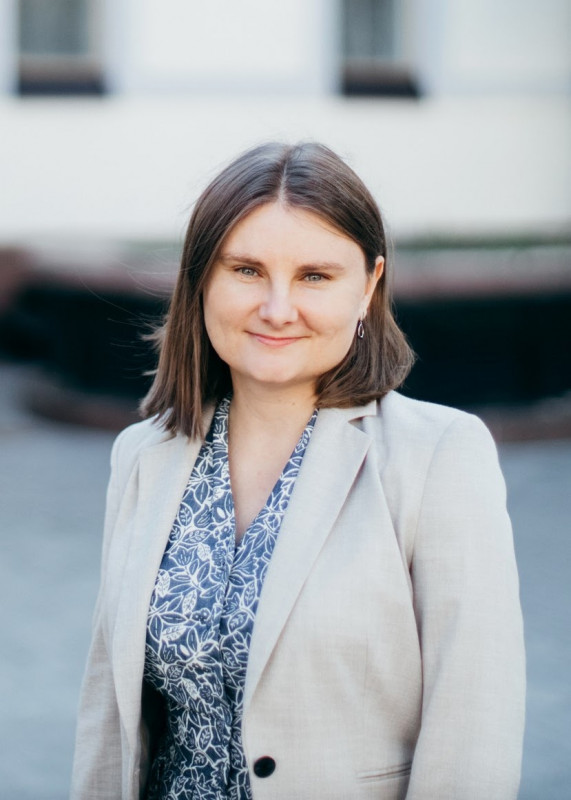
Olesya Bondarenko is a philosopher of science, specialising in philosophy of biology and philosophy of the social sciences. She received her PhD in History and Philosophy of Science from the University of Cambridge in 2024. Her philosophical interests relate to integrative biosocial research, causal evidence and explanation, and the role of ethical and political values in science. She is particularly interested in behavioural genetics and genomics and their recent integration with the social sciences (sociogenomics). Olesya has developed and taught courses in philosophy of science at the University of Vienna and Kyiv School of Economics.
