

News Details
In a recent paper published in Frontiers in Cell and Developmental Biology, KLI Postdoctoral Fellow Somya Mani and Tsvi Tlusty (Ulsan National Institute of Science and Technology, Republic of Korea) present a new agent-based model of cell-fate decisions in tissues.
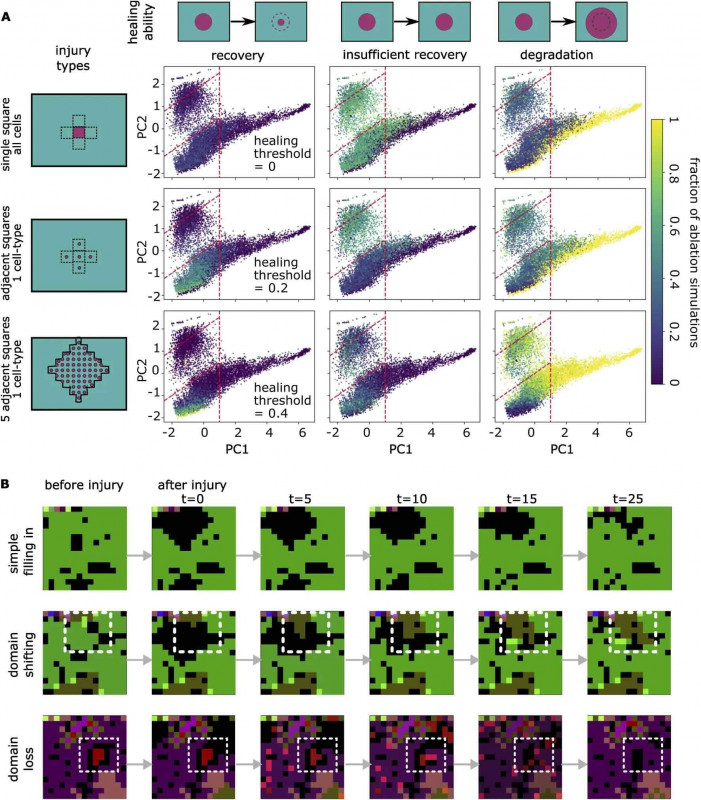
Across the multicellular tree of life, cells tend to be organized into tissues, which are arrangements of cells of different types that achieve a common function. While the functions of tissues are diverse, tissue structures across organisms as different as plants and animals tend to be strikingly similar: tissues are organized into distinct domains of well-defined cellular compositions and different domains have precise adjacencies among themselves. In this work, we used a generative modeling approach to understand the evolutionary and developmental basis of tissue structure. Our results indicate that the ability of tissues to heal is strongly linked to tissue structure: tissues with large and contiguous domains, which resemble natural tissues, heal better. Additionally, model-generated tissues predominantly healed through the replacement of injured cells by cells dividing in the neighborhood—this recapitulates the mechanism of tissue healing that is prevalent in animals and plants. Our work thus points to general patterns that are often difficult to directly compare in empirical research. Despite the multiple evolutionary origins of multicellularity, the link between tissue structure and healing capacity may represent a unifying feature of multicellular life.
Publication:
Mani S and Tlusty T (2026) Linking tissue morphology and tissue healing in a cell-fate model. Front. Cell Dev. Biol. 14:1845953. doi: 10.3389/fcell.2026.1845953